

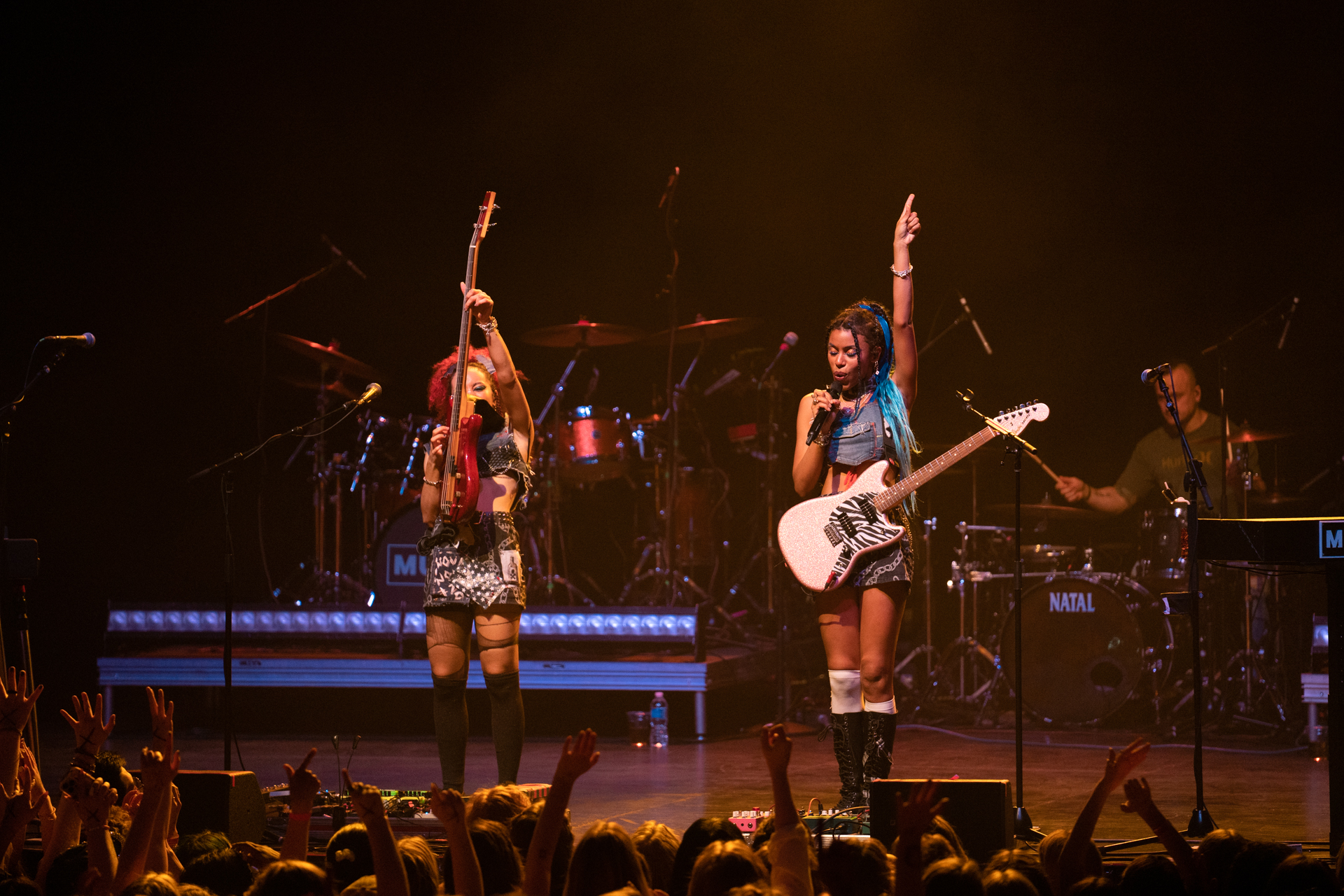
The music industry hasn’t always been an easy ride for the Nova Twins, a two-person genre-blending band that hails from London. They’ve admitted that they had to “kiss a lot of frogs” in the industry. The duo, who have been performing together for a decade, released their debut album in Feb. 2020, about a week before the COVID-19 pandemic broke out.
They spent the pandemic working on their 2022 follow-up, Supernova. The band’s also been touring, a lot. After wrapping up a tour opening for the Foo Fighters, who they refer to as “lovely,” Nova Twins are now wrapping up a quick tour of the United States, before heading back to Europe, where the duo will be playing festivals throughout the summer.
We hopped on a Zoom with the Nova Twins before their May 17 Chicago show at the Cobra Lounge to talk about their current tour, what it’s like to be a woman in rock music, and how the rumors are true: Dave Grohl is a gem.
Staged Haze: So you’re having an exciting year. I know you’re doing headline shows right now, but you’ve also been opening for the Foo Fighters. What have some of the highlights of this year been for you so far?
Amy Love: To be honest, our year didn’t start until the Foo Fighters tour. We’re writing an album, so we’ve been in our caves.
Georgia South: Yeah, we’ve been at home, writing, writing, writing for months. Our first show back was Foo Fighters, so that was a rush going from, like, being at home just writing away, to playing in front of an amphitheater. It was so fun.
SH: What was it like opening for the Foo Fighters? I can’t imagine what that would be like.
AL: It was very surreal, because the whole band, they’re obviously one of the biggest bands in the world, but at the same time they’re so lovely. Dave’s lovely, Chris, Pat, Nate, all of them. They’re super welcoming, and it wasn’t like “We’re the headline band, don’t look at us, don’t be with us.” It was like “Hey, come on in!” And the crew were amazing, we’re very lucky.
SH: Wow, I can’t wait to tell my mom about this. She is a massive Foo Fighters and Dave Grohl fan, and it’s good to hear the rumors are true.
AL: People are like, don’t meet your heroes. But, if your hero is Dave, definitely meet him.
SH: That’s so cool. Obviously, you’ve opened for some pretty huge names, like the Foo Fighters, recently. What does it feel like to now be on your own and headlining these shows?
GS: I think it will be nice to see our audience again. When you’re doing support or playing festivals you’re trying to win people over and meet people for the first time, but when you play your own shows it’s like seeing old friends. It’ll feel like a reunion with them all, so we’re excited to see them again and be in a smaller venue where it’s more sweaty, and punky and chaotic. It’s going to be wild.
SH: With your debut album, it was dropped, like, a week before the pandemic broke out. What was that experience like? You obviously couldn’t go out and support the album in person.
GS: When we released it, we did 10 shows in France as part of that tour, and then we had to run back to the U.K. because France was shutting down. We’re like, “We need to make it back to the U.K. before they close everything off.” So it was just running back, and we made it. I feel like in the lockdown we got quite lucky because people were discovering new music, and they were searching for new artists to listen to. I feel like the album didn’t die out completely, it had legs, which we’re so grateful for. Obviously for loads of bands it was really hard to stay afloat during the pandemic, with funding and things like that. Loads of grants helped us be able to keep going, and we just ended up writing Supernova all through the pandemic.
AL: At our leisurely time.
GS: Yeah, we wrote Supernova and would go outside and sunbathe for a bit, and then write a bit here. We just wrote it over the whole pandemic, which was great.
AL: No pressure, no touring to get in the way.
GS: No one was waiting for it. It was our second album, but it felt like our debut because it was like we had all of this time. But this album definitely feels more like the second album, whereas people are like, waiting for it, and there’s a time limit.
SH: What did it feel like once you were able to finally go out and perform, see your fans and do all the typical album promo things?
AL: It was a different experience. When you’ve been indoors for a long time, and you’ve been cut off from each other, we were more socially awkward and everything felt really intense. We were probably a bit rusty, but it all came back. We were just so excited to be gigging again. It started off weird, we’d do virtual gigs. So, we were allowed to leave and go somewhere, like a studio, and do a gig there. It wasn’t great.
GS: They were boring.
AL: It was a bit flat, it wasn’t quite the same. But once we started playing a few more festivals, it felt incredible.
GS: When we came back we played two smaller festivals to ease ourselves in, and then it was Reading and Leeds, which is a really big festival in the U.K., so we were like “Oh, shit.” Straight after Reading and Leeds, we were on the Bring Me the Horizon tour, which was in arenas, and that was our first time doing arenas. We literally felt like Hannah Montana, we had just been at home in our pajamas, and now we’re in a fucking arena. It was crazy, it felt like a movie. It was the most anxiety ever, but also, we had the best time. It was so much fun.
SH: Hahaha, I love the Hannah Montana comparison. Going along with you playing live—every picture I’ve ever seen of you two performing live, your outfits are so cool. How do you pick out what you wear on stage? What are you main fashion inspirations?
AL: We’ve always made our clothes, or customize pieces.
SH: You make them?
AL: Well, we have done a lot. Yes, a lot of them are. This tour, as we’ve run out of time with writing the album, we’ve actually worked with an amazing stylist called Lyla Cheng. We worked with really cool, small designers, local. We said “This is what our vibe is for the tour,” and picked some stuff, and we threw things together. Today, we’re actually wearing an outfit that we’ve made and customized. It’s always a mix of small designers, our own clothes, things that we’ve quickly hemmed together, stitched, or found in thrift shops. We’ve been thrifting.
GS: We’ve been thrifting so hard. We’re thrifting and then just wear it on stage, and will pin it in so it fits. It’s actually been so fun thrifting.
SH: Listening to your music, it’s so unique and such a confluence of genres and influences. Who are some of your main influences, and how do you go about your writing process?
GS: I think our influences, we love so many different genres. We’ve never been bracketed into one genre. It could be anything from N.E.R.D., to Betty Davis, to Missy Elliot, to James Blake, to Stevie Wonder growing up, or Donny Hathaway. I think we listen to so much.
AL: New York Dolls, Kate Bush, Joni Mitchell.
GS: I think that’s what we put into our music. We’re never like, “Oh, we’re going to write a rock song today.” We just sit there, and whatever comes out, whatever we’re feeling comes out that way. We’ve always trusted that process, where the music is just our gut feeling. That’s how we went into this writing process again. We’re just at home, writing through the winter in gray Britain.
AL: It’ll be the first thing that we do when we wake up, and it becomes a little bit unhealthy. The first thing you do, you’re in pajamas and the first thing you do is go straight to the laptop because you’ll be finishing up an idea that you’re trying to get into from the night before. Then you go to bed thinking about it, “How can this be better?” It was different.
GS: The deadline was a different type of pressure, because we’ve never worked with a deadline before. On your debut, you have, like, your whole life to write a debut album. And we had the whole pandemic to write the second album.
AL: We never knew what it was like to write under a deadline.
SH: Your music is very genre-blending, but you’re also described as a nu metal band. I took note of that because my brother is a big nu metal fan. I’ve seen Limp Bizkit in concert with him quite a few times. At least in the US, nu metal has this stereotype as being a genre for angry white men. How does it feel to not only be women who are kind of creating music in this realm, but also to be women of color?
GS: I feel like we’ve never said we were a nu metal band, or a rock band.
AL: Someone called us something else the other day, hyperpop.
GS: Yeah, hyperpop, or cyberpunk. There’s been so many different names, where we just called ourselves the Nova sound. We don’t want to put a label on it. People say we’re a nu metal band, and that’s their take on it, and that’s completely fine, but we don’t really look at it in that way.
AL: What’s interesting is we do play nu metal festivals, and metal festivals. We’ll play rock festivals and pop festivals as well. I think it’s quite fun, and we’ve supported nu metal bands, or have had them support us. It’s funny with genres, isn’t it? We’re pulling from a lot of different things. That’s definitely one of them. I feel like nu metal these days means something different to, like, Limp Bizkit, or Rage Against the Machine, and all of those bands. I think it’s way more open, and I think bands, especially now, are experimenting with a wider genre palette.
People are putting all sorts of things in their music, which is so exciting, because when we were first doing it, people were like “I don’t know where to put you. You’re not quite hip hop, but you’re not quite white, male rock either.” It was always a bit confusing for people, but it’s nice to see that the genres, and the gatekeepers are opening their minds and their conception of what is a rock band and what is a nu metal band, and how women, and women of color fit into that. We’ve just trying to be bashing down doors as much as we can for our whole time as a band, and it’s something that we continue to be doing, along with our peers.
GS: It’s nice to see things change. From when we first started, we’d be the only band that looked like us on the bill.
AL: And the only women, sometimes. It’s weird.
GS: It did feel quite like, even though the audience was welcoming, it did feel isolating backstage, when you didn’t see anyone to, like, connect with in that way who understands the same feeling. Now, being backstage at festivals, you can see that there’s so many more women, so many more non-binary people, and people of color playing these heavier festivals. There’s still a long way to go, especially with people of color in rock bands, but it’s definitely improved from when we first started playing. We always felt like it’s not okay to just be the token band playing the festival. We’d be on it, but it’s not enough that we’re the only band that looks like us there. We’re always trying to keep the door open and be like, let’s bring in so many more bands because they’re all incredible and they deserve that platform as much as anyone on the bill.
AL: And we need to give women more credit, as well. When we see all these headliners, especially in the rock genre, where are all the women headlining? Where are they? I mean, Evanescence, Amy Lee, they should be headlining. I know they probably do some festivals, but it’ll always be, like, Guns ‘n’ Roses, or KISS, or Metallica. They’re all obviously amazing bands, and we love those bands, but it would be really amazing to see, like, Alanis Morisette. They don’t get the same credit. I think the idea of women headlining the rock genre, we’ve definitely got a long way to go with that to make it feel like as much as the men. It’s not on that level yet.
SH: I was just at a festival, and just about all of the headliners were men — there was one woman in one band. It’s so normalized that you don’t even think about it sometimes. There were plenty of women playing early in the day, but there weren’t really any headliners.
GS: We need to nurture them to become the headliners, or put them in these situations where they will become the next headliners.
AL: There’s not the path for it, at the moment. There seems to be a really easy path for male rock bands to blow up. You can blow up, and suddenly be a headliner. But for women, you can blow up, and it feels like a slower trajectory. Even then, you’re easily forgotten about, or seen as like “Oh yeah, that cool band…” like L7, or Bikini Kill, or Joan Jett. But it’s never, like, “We’re the Beatles!” Hahaha. We need to make that happen. We’ve got a way to go.
SH: I can’t wait until you’re headlining a festival, and I can go and cheer you on. So, I read that you’ve been working on music together for a decade. How have you grown together, and what have you learned about each other over the last 10 years?
GS: I think we’ve grown so much in the time. From when we were younger to where we are now, that’s such a big growth in life. Everyone grows the most in that time. I feel like we’re more sure of ourselves. I think before we were so naive going into everything, we didn’t know how anything worked in the music industry. We were just like “We want to play in a band!”
AL: “We want a major record label deal!”
GS: “We want to go to LA and get a major label deal, and that’s it, that’s how people get big.” Because you don’t really know when you’re young. We’ve learned a lot of lessons. We’ve had to kiss a lot of frogs.
AL: A lot of frogs. Musical frogs.
GS: We did so many shows, and we’d get so nervous for weeks before a show. But we’ve been taking it in stride, and taking on loads of pressure. We had the craziest year touring everywhere for “Supernova.” That was a lot for us to take on and grow.
AL: You understand touring, as well. It’s actually quite mentally draining. People would say “It’s so glamorous that you’re on tour,” but, unless you’re living like the Foo Fighters, or Beyoncé, that’s glamorous! Especially if you’re from the U.K., coming to the U.S., you’re trying to make ends meet out here. It’s costly to be on the road and take the crew out. You can’t always live comfortably. And these spikes of adrenaline that you’re having every day, and you think “Why do I feel a bit low today?” It’s because everything is spiking and dropping. You start to really understand how to mentally look after yourself. If one of us needs space, or someone is down in the crew, we understand how to really work as a unit.
GS: We’ve learned that we’re both really resilient on tour as well, because not many people tour as much as we do. We love it. We’re touring, touring, touring all the time. But we’ve definitely learned that we are really resilient, and we know each other so well. We can move like water, and know what each other needs. When the band started before that, we were inseparable anyways, so that really helped when we go on tour. It didn’t feel like “Oh my god, we’re sharing a room every day,” or anything like that. We did it anyway. It really was helpful. Some bands are like “What are we going to do, stuck in a van with this person?”
AL: And we’re like “We’re in America! Let’s go thrifting!”
GS: So, that is totally amazing.
AL: You do learn a lot. As people, as you grow, hopefully you’re learning, and we’ve still got so much to learn as our career goes on, and if we reach different heights and have different experiences. We always want to push ourselves and challenge ourselves, and be like “Okay, let’s go in the deep end, because we don’t want to be complacent.” There’s so much more that we really want to do. Even after all of the years, we’re still hungry. That fire’s still very much burning, and it’s something that we just love.
Photo by Drew Bouman for Staged Haze, Nova Twins opening up for MUNA on 5/17/23 at The Palace Theatre.
0 comments on “Chatting with Nova Twins About Touring, their New Album and Feeling Like ‘Hannah Montana’”