

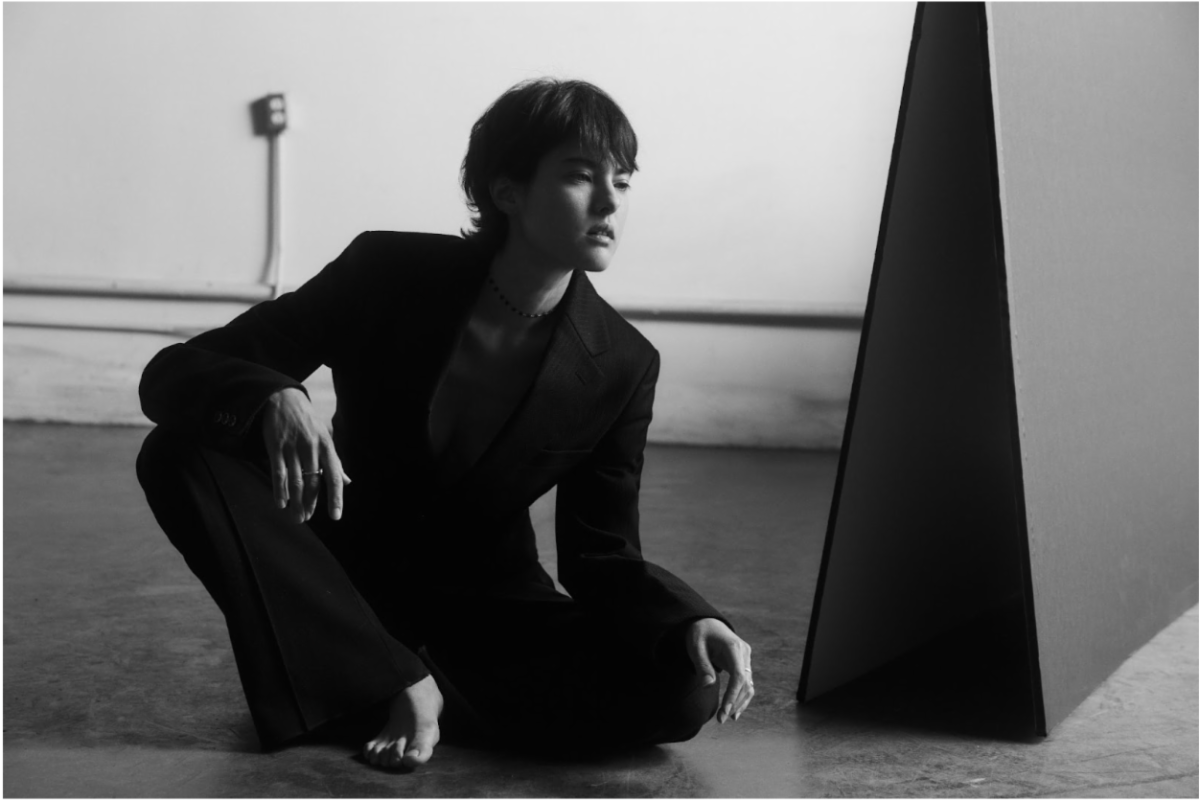
Miya Folick’s Erotica Veronica is out today, marking a bold new chapter in her artistry. Announced in December of last year, the album is her third full-length record and her first entirely self-produced project. It’s an album that feels deeply personal and unfiltered, exploring desire, rage, tenderness, and self-possession with striking honesty. Across eleven tracks, Folick moves seamlessly between hushed intimacy and raw catharsis, crafting an album that feels like both a confession and a reclamation of power.
From the very first moments of “Erotica,” it’s clear that Folick is embracing both the delicate and the gritty, balancing soft acoustic melodies with deep emotional intensity. Sonically, the track feels sparkly and upbeat, with an airy acoustic guitar and a sing-songy melody that makes it feel deceptively light. But the music video tells a much darker story. Folick moves through scenes of indulgence and self-destruction—rolling in mud, gorging on a piece of watermelon, writhing in a trance. The contrast between the song’s warmth and the video’s unsettling imagery mirrors the album’s overarching themes of pleasure, self-exploration, and the ways we consume and are consumed by desire. “How did we get here?” she asks in the opening line, a question that lingers long after the song ends.
That tension continues with “La Da Da,” an acoustic-driven track with a nostalgic sweetness. The chorus is effortlessly catchy, but the lyrics hint at something deeper. “Driving halfway down the speedway” captures the feeling of moving forward but never quite arriving, lost in thought but still in motion. It’s breezy on the surface, but there’s a wistfulness beneath it.
“Alaska” introduces a deeper sense of fragility. The harmonies create an eerie, spectral effect, while Folick repeats, “I could lose you.” The way she lingers on the phrase makes it feel heavier each time, capturing that moment of realization when love and loss become indistinguishable.
“Felicity” is one of the album’s most immediately striking tracks, transforming everyday observations into something almost mystical. “Sweet sound of a rare bird with combination skin” is such a specific, intimate detail, yet Folick delivers it in a way that makes it feel universal. The song shimmers with an ethereal quality, her voice floating above the instrumentation like an incantation.
Then comes “Fist,” released as a single on January 29 of this year, ahead of the album’s release. It trades the dreamy mysticism of “Felicity” for brutal honesty. A slow-burning acoustic track, it’s a meditation on inherited rage and self-destruction. “This rage is my inheritance,” she sings, her voice barely above a whisper, before launching into one of the album’s most visceral climaxes. The scream at the end is raw and unfiltered, the kind of release that feels both deeply personal and profoundly cathartic. In the full context of Erotica Veronica, it’s the moment where all the album’s simmering tension finally erupts.
“This Time Around” shifts the mood again, offering a quiet moment of contemplation. The delicate guitar strums and hushed vocals paint a picture of longing laced with anxiety. The line “filled with dread” is simple but devastating, capturing the way love can be both comforting and terrifying.
“Prism of Light” leans into a more electronic, shimmering sound, reminiscent of Grimes but still unmistakably Folick. It floats between soft pop and indie rock, playing with texture and space, creating a sense of expansiveness even in its quiet moments.
Then there’s “Hate Me,” a slow-burning meditation on a relationship that didn’t work. “Let me keep my name” is such a quietly powerful lyric—a plea for autonomy even in the aftermath of heartbreak. “If you hate me, it’s out of my control” feels like a surrender, not to bitterness, but to the fact that sometimes things fall apart no matter how hard we try. There’s a Mitski-like introspection to it, a willingness to sit in discomfort and let the emotion simmer.
As the album moves forward, “Hypergiant” introduces an almost supernatural quality. The operatic vocal layers give it an untouchable, celestial feel, reminiscent of Caroline Polachek’s ability to make music that feels both ancient and futuristic.
“Love Wants Me Dead” shifts the energy again, bringing in a grungier, rawer sound with echoes of Fiona Apple. The guitar solo feels like it’s clawing its way out of the mix, amplifying the sense of unease that runs through the song. Love, in this world, is not just a gentle force—it’s something all-consuming, something that demands and takes.
Closing the album, “Light Through the Linen” is like an exhale after the storm. The acoustic arrangement is delicate, the harmonies soft, but the imagery is striking. “I see lotus flowers blossom in the mud” is a beautiful, quiet moment of resilience—a reminder that even in darkness, growth is possible. It doesn’t wrap things up neatly, but it offers a kind of acceptance.
What makes Erotica Veronica so compelling is its refusal to settle. The album shifts between folk, indie rock, electronic, and grunge influences without ever feeling scattered. Instead, Folick uses those shifts to underscore the complexities of identity and desire. Her voice is acrobatic—sometimes whisper-soft, sometimes breaking into a scream—but always full of intention. Every song feels urgent, every lyric feels lived-in.
If Premonitions and Roach were about discovering oneself, Erotica Veronica is about fully stepping into that self, contradictions and all. It doesn’t just explore contrasts—it lives in them. In doing so, Folick has created something more than just an album; it’s an experience, an invitation to embrace every part of ourselves, the delicate and the gritty alike.
Erotica Veronica is out now. Listen to the album, and catch Miya Folick on the “Erotica Veronica” tour this April to experience its electricity live.
Pingback: Miya Folick’s ‘Erotica Veronica’ Tour Hits Brooklyn—and Becomes a Night to Remember