

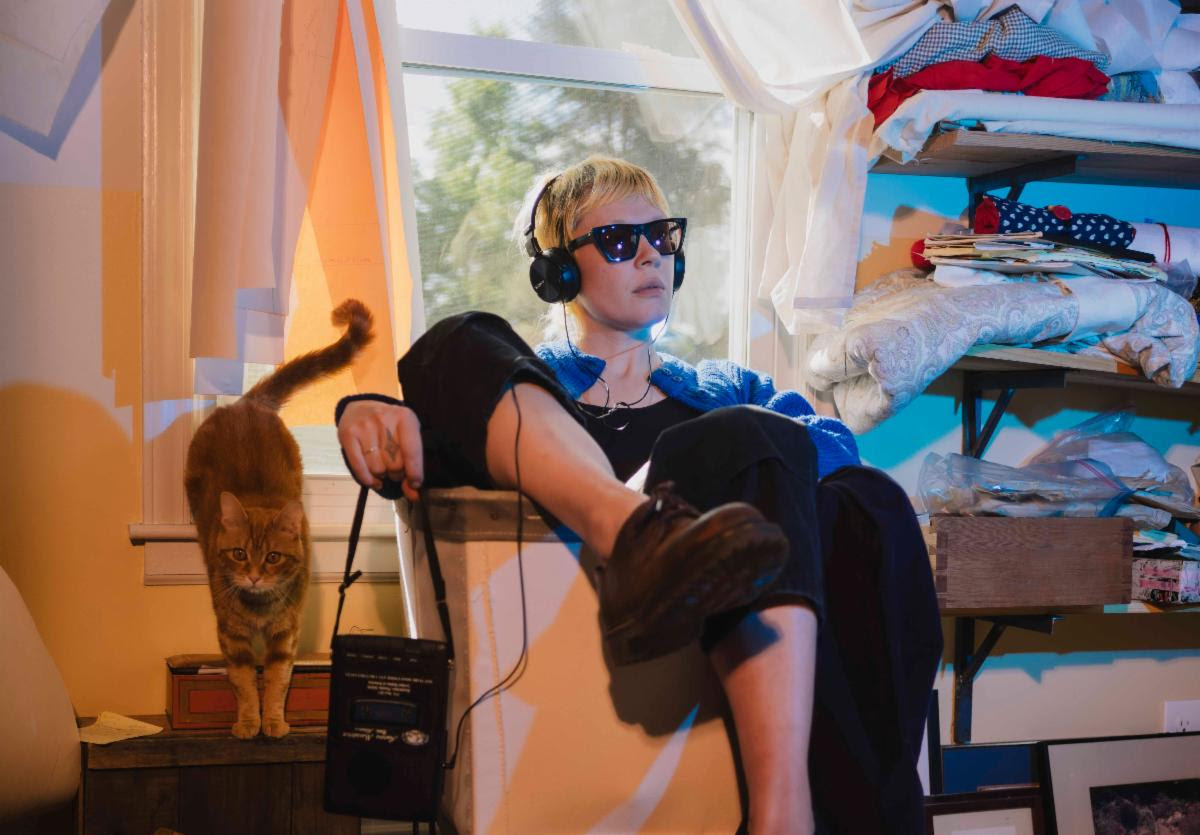
Alex Sauser-Monnig has been a familiar name in indie music for a while now. As one-third of the folk trio Mountain Man, one half of the experimental pop duo The A’s, and the voice behind their solo project Daughter of Swords, they’ve always been part of projects that feel personal and community-driven. In 2019, they released their first solo album Dawnbreaker— a hushed, acoustic-heavy breakup record that leaned into stillness and self-reflection.
Their second album, Alex, is a different story entirely. It’s louder, weirder, and way more fun — like someone who’s gone through something and come out the other side with more questions than answers, but way more energy. If Dawnbreaker felt like sitting with your feelings in a quiet room, Alex is about getting up, going outside, and seeing what happens when you let life—your thoughts, your desires, your relationships—be a little messy.
The album opens with “Alone Together”, which starts with bare vocals before jumping into sunny, upbeat guitar rock. It’s about craving intimacy while trying to protect your space — a feeling that runs through much of the record. It sets the tone right away: this is going to be vulnerable, but it’s also going to be catchy and bright.
“Talk To You” continues in that lane. The song is built around the repeated lyric “I really wanna talk to you / I really wanna know you,” and while it’s incredibly simple, there’s something about the repetition that makes it hit harder. It sounds like someone working something out in real time, and the minimal production keeps that feeling front and center.
From there, the album opens up into stranger, more playful territory. “Hard On” is one of the most fun tracks here — the vocals are full of personality, giving off a flirty, chaotic energy that reminded me a little of Tune-Yards. “Morning in Madison” is the total opposite: sweet and sleepy, with light drums and a bassline that feels like a gentle stretch. The horns sneak in slowly and add this perfect warmth to the track—it’s a quiet highlight.
“Money Hits” is a real joy, complete with a literal cash register sound effect and a piano melody that could soundtrack a spontaneous dance break. It’s upbeat without being overproduced, and it captures the kind of everyday thrill that feels rare in pop music. “All I Want Is You” follows with a stripped-down approach: a groovy bassline and a looping vocal that builds like a daydream.
“Willow” leans into sweetness again, starting with a soft piano intro that wouldn’t sound out of place on a Sara Bareilles record. The horn returns here too, giving the song an emotional softness without making it overly sentimental. It feels lived-in, like something you’d play on a slow walk home.
On “Dance”, Sauser-Monnig fully lets loose. The track is sensual and sparkly, with a rhythm that feels like waves crashing in slow motion. The delivery is confident and slightly hypnotic, and there’s a subtle Fiona Apple energy that gives it just enough edge. It’s a total vibe shift, in the best way.
Then comes “Strange”, which might be the album’s most direct emotional statement. It’s got one of the catchiest choruses here, but the lyrics cut deep: “I feel strange / But it’s just a natural reaction / To a world coming apart at the seams.” It’s hard not to relate — and harder not to nod along.
“Vacation” is exactly what it says it is: breezy, relaxed, and just a little removed from everything else. “Song” brings the tempo back down completely. It’s an acoustic lullaby with simple, intimate lyrics — “sing me a song to sleep to / a song to smile to” — and it feels like a quick check-in with the version of Sauser-Monnig we met on “Dawnbreaker”.
The album closes with “West of West”, pairing light piano and electronic drums with soft, natural imagery. “Waves crashing on the beach, wind blowing through the trees,” they sing. It’s a peaceful moment that lets the album land gently, without trying to tie things up too neatly.
One of the reasons Alex sounds so expansive is because of who helped make it. It was recorded at Betty’s, Sylvan Esso’s studio in Chapel Hill, North Carolina, with a crew of longtime friends and collaborators including Amelia Meath (of Mountain Man and The A’s), Jenn Wasner, Nick Sanborn, and more. You can hear some of that Sylvan Esso influence in the production — the clean beats, shimmering textures, and little moments of sonic experimentation that sneak up on you. The songs stay emotionally grounded, but there’s a looseness here that gives the whole album its pulse.
Alex doesn’t abandon what made Dawnbreaker special—the emotional clarity, the sense of introspection — but it reframes it with more confidence and a lot more movement. There’s desire, joy, longing, frustration, and a willingness to not have everything figured out. Sauser-Monnig sounds like they’re exploring in real time, and the result is a record that feels totally alive.
Alex is out now.
0 comments on “Daughter of Swords Returns with ‘Alex,’ an Album About Craving, Change, and Letting Life Be Messy”