

In the last ten years, only one man has won Best New Artist at the Grammys. In 2024, female artists dominated 63.4% of the U.S. Top 100 pop streams in the United States: the same year where eight of the 10 most-streamed albums of the year on Spotify came from women artists.
So why is it that out 79% of women in music are performing musicians, but only 15% of live sound engineers and 12% of studio/mastering engineers are women? Or that in 2025, only 22% of the musicians booked for major U.S. music festivals were women?
These are questions that many industry professionals are continuing to scratch their heads at, considering how much the data shows that women have continued to dominate popular music over the last decade and beyond.
Organizations like Book More Women use their social media platforms to pressure the powers at be to build more inclusive festival lineups, meticulously calling out major U.S. festivals for continuously overbooking men under-booking women and nonbinary artists. Just last month, they reported that Minnesota Country Club takes last place for their 2026 lineup, featuring only 6% women and 4% nonbinary artists, followed by Stagecoach (13% women artists and 0% nonbinary artists), and Railbird (14.7% artists and 0%, respectively artists). But not everything is rage-inducing: Hinterland Iowa’s lineup is comprised of 59.6% women artists and 5.8% nonbinary artists, and All Things Go is lands at #1 for representation with 68.2% women artists and 9.1% nonbinary artists.


The work for more representation and inclusion has inspired artists like Zealyn to make change in her own way, too. She started Push-Up Bra LA back in 2020 with a sold-out live music showcase featuring an all-women lineup. Since then, the non-profit organization has showcased 45 femme artists across 12 live music events, created a catalog of 60+ songs through all-women songwriting camps, connected more than 2,000 women through the community, and more.
I spoke with Zealyn just a couple days after Support the Girls Fest about the nonprofit’s origin story and what she hopes to achieve.
“I started [Push-Up Bra LA] out of necessity. I did my own artist project for 10 years and just saw the lack of women in the room, the lack of women in executive roles, the lack of women in live spaces. That’s what truly led me to start Push-Up Bra LA—just as a live showcase at first. In 2023 [after COVID], we brought Push-Up Bra LA back on a larger scale. Not just live shows, but with camps, networking events, workshops for teen girls, and we’re starting new programming soon—in April—but at the end of the day: the main goal is to bring passive income to women in music. To bring them visibility, empower them, and connect them with one another. This industry, as everybody knows, is very isolating. You work so hard towards your own dreams, there’s never a rest, and it’s good to force those rests every once in a while and connect, meet other women, and just remind yourself ‘Wow, we’re killing it. We’re all so talented and we all deserve it.’”

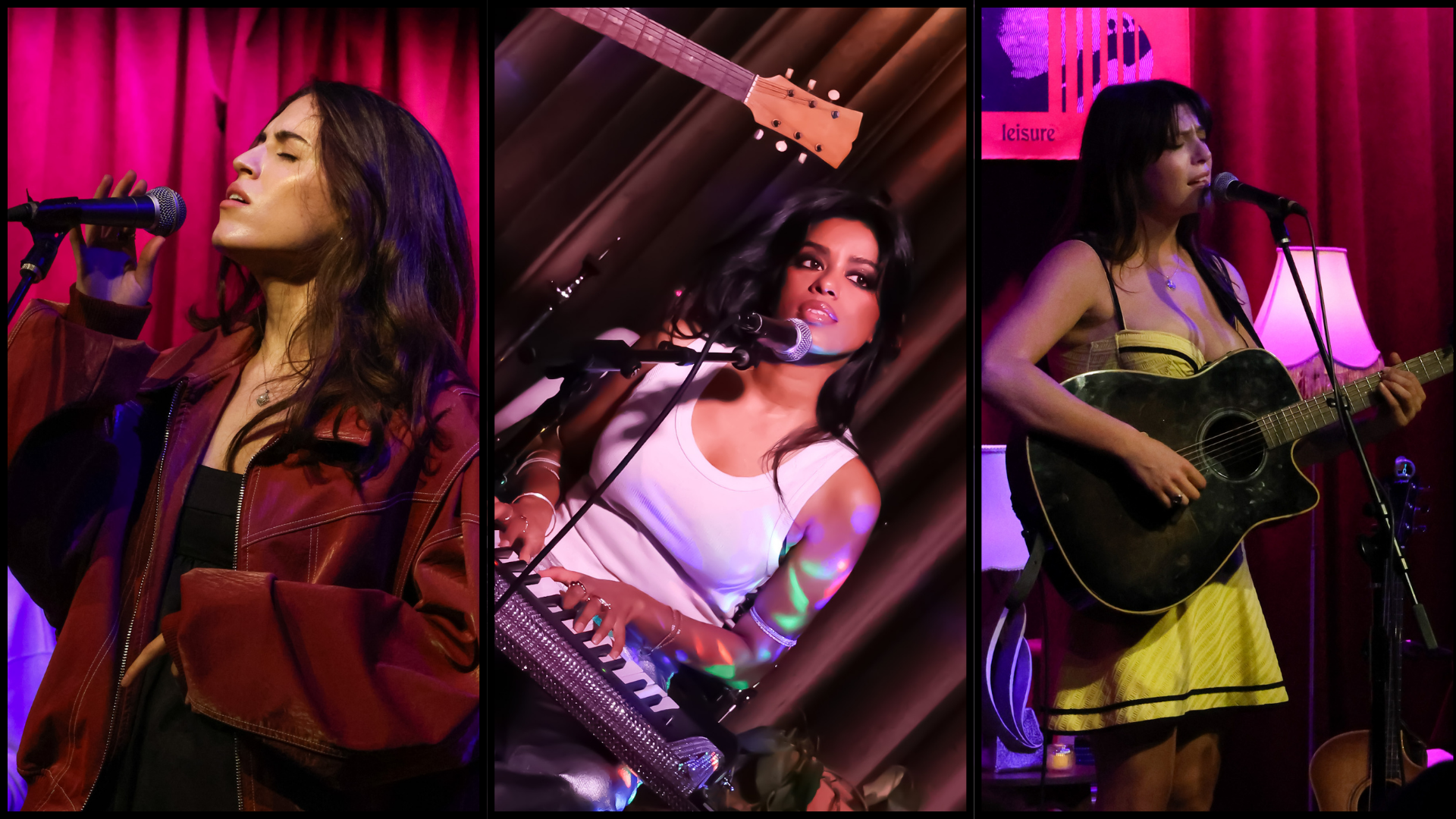
March 8, 2026 was the perfect time for Push-Up Bra LA’s first Support the Girls Fest: it happened to land on International Women’s Day and also the 6th birthday of Push-Up Bra LA. Taking place at Los Angeles’ iconic Hotel Cafe, which is set to close its doors and re-open in a new location in 2027, Support the Girls Fest served as a fundraiser for Push-Up Bra LA’s 2026 programming, and took over both stages at the Hotel Cafe with over 15 performances from artists like Carol Ades, Debbii Dawson, Grace Enger, Ella Jane, and others: plus food and desserts, tooth gems, vintage and custom jewelry, and more for sale from local businesses.
According to Zealyn, Push-Up Bra LA’s live music events give artists an average of $700 for an acoustic show, way above the average rate of a working musician in Los Angeles. “I pursued my artist project full time for 10 years, she said. I know what it’s like for every single bone in your body, and every ache of your heart to need this outlet for creativity. I get that passion and that drive so deeply. So when I see Push-Up Bra LA events or programming make an artist light up and feel respected and feel worthy for a night, it’s something I wish I had. I wish I had that feeling when I was an artist.”


L-R: Debbii Dawson, Lindsey Lomis, Ally Salort
It’s a feat in and of itself to sell out an event like this as a non-profit organization, and it’s another one to actually produce an event that pulls people to arrive early and stay late—not to mention that it took place on a Sunday. But Push-Up Bra LA managed to do just that: with music starting as early as 6:30pm and concluding at 11:05pm. Artists performed 20 to 35 minute sets to intimate crowds across two stages with staggered set times, making it easy for attendees to bounce back and forth between rooms with ease. For one night only, the future of more women representation in live music not only felt realized, but inspiring, and fully attainable. Clearly, there is and will continue to be a market for this.


L-R: Grace Enger, Ebony Loren, Carol Ades
Though there was a ton of different types of music showcased throughout the evening: R&B, singer-songwriter, indie, pop, soul, and others, the message of the evening stayed consistent: how the artists hoped that being part of events like these and the work that Push-Up Bra LA has been doing for years makes lasting change. Every single artist I saw perform spoke about their gratitude for Push-Up Bra LA and how the community has allowed them to not only be seen, but be heard and understood. “I get so emotional and moved when an artist comes up to me and says ‘wow, that was the best showcase I’ve ever played’ or ‘wow, that writing camp felt different. I felt cared for.’ That feedback is what makes everything worth it. I didn’t have much of that when I was doing my artist project. The ability to give that feeling to an artist, it just doesn’t get old,“ Zealyn said.
Lindsey Lomis, one of the musicians performing at the showcase, who has toured with artists like Jacob Collier and Joshua Bassett, spoke onstage about her time as a child growing up in Nashville and attending songwriting camps. “Hopefully [Push-Up Bra LA] can help make it the norm for every little girl out there” to get more access to skills like songwriting and performing. With more programming on the horizon, including more showcases (every other month, the next one taking place in May) and content creation with artists, Push-Up Bra LA hopes to provide women in music more of a passive income.


L-R: Christine Noel, Ella Jane, Merges
The charts may already belong to women, but spaces like Push-Up Bra LA are making sure the industry does, too. By creating opportunities, community, and real financial support for artists, the team behind Push-Up Bra LA is helping close the gap between who dominates the music and who gets the platform. If Support the Girls Fest showed anything, it’s that when women are given the room and the resources, they show up for each other.


L-R: Sarah Dafne Grey, Léa the Loux, Nia Ashleigh
Check out Push-Up Bra LA’s website HERE and Instagram HERE.
Photos by Samantha Moschetti for Staged Haze
0 comments on “Inside Push-Up Bra LA’s ‘Support the Girls’ Fest and the Mission to Make the Industry more Accessible for the Women who Dominate it”